
Where Did the Mausoleum of Halicarnassus Actually Go?
Short answer: the Mausoleum of Halicarnassus never left Bodrum. It was quarried, carved up and rebuilt into the town around it — and once you know what to look for, you can spend an afternoon finding pieces of a Wonder of the Ancient World hiding in plain sight.
Of the seven wonders the ancient Greeks listed, only the Great Pyramid still stands. The Mausoleum was the second-to-last to fall, and it fell here, in the middle of what is now Bodrum town. Most visitors walk past its site on the way to lunch without realising it. This is the story of where it went.
What the Mausoleum actually was
In the 4th century BC, Halicarnassus — today's Bodrum — was the capital of Caria, a wealthy satrapy on the edge of the Persian Empire. Its ruler, Mausolus, spent decades turning a coastal town into a showpiece city: a fortified harbour, a theatre cut into the hillside, walls running up the ridge behind it.
When Mausolus died in 353 BC, his sister and wife Artemisia II commissioned a tomb on a scale nobody had attempted for a mortal ruler. The result was roughly 45 metres tall: a high rectangular podium, a colonnade of 36 columns, a stepped pyramid roof and, at the summit, a four-horse marble chariot. Four of the most celebrated sculptors of the Greek world — Scopas, Bryaxis, Timotheus and Leochares — are said to have taken one side each.
It was so far beyond the normal scale of a grave that the man's name became the word. Every mausoleum built anywhere in the world since is named after a Carian ruler buried in Bodrum.
How do you lose a building that big?
Slowly, and then all at once.
The Mausoleum survived Alexander the Great's siege, the Roman period and well over a thousand years of Byzantine rule — it was still standing, at least in part, into the medieval period. What brought it down was the ground itself. A series of earthquakes between roughly the 12th and 15th centuries collapsed the colonnade and the roof, leaving a mountain of dressed marble on a hillside above a harbour.
And a mountain of dressed marble, in the 15th century, is not a ruin. It is a building supply.
Follow the stones: the castle
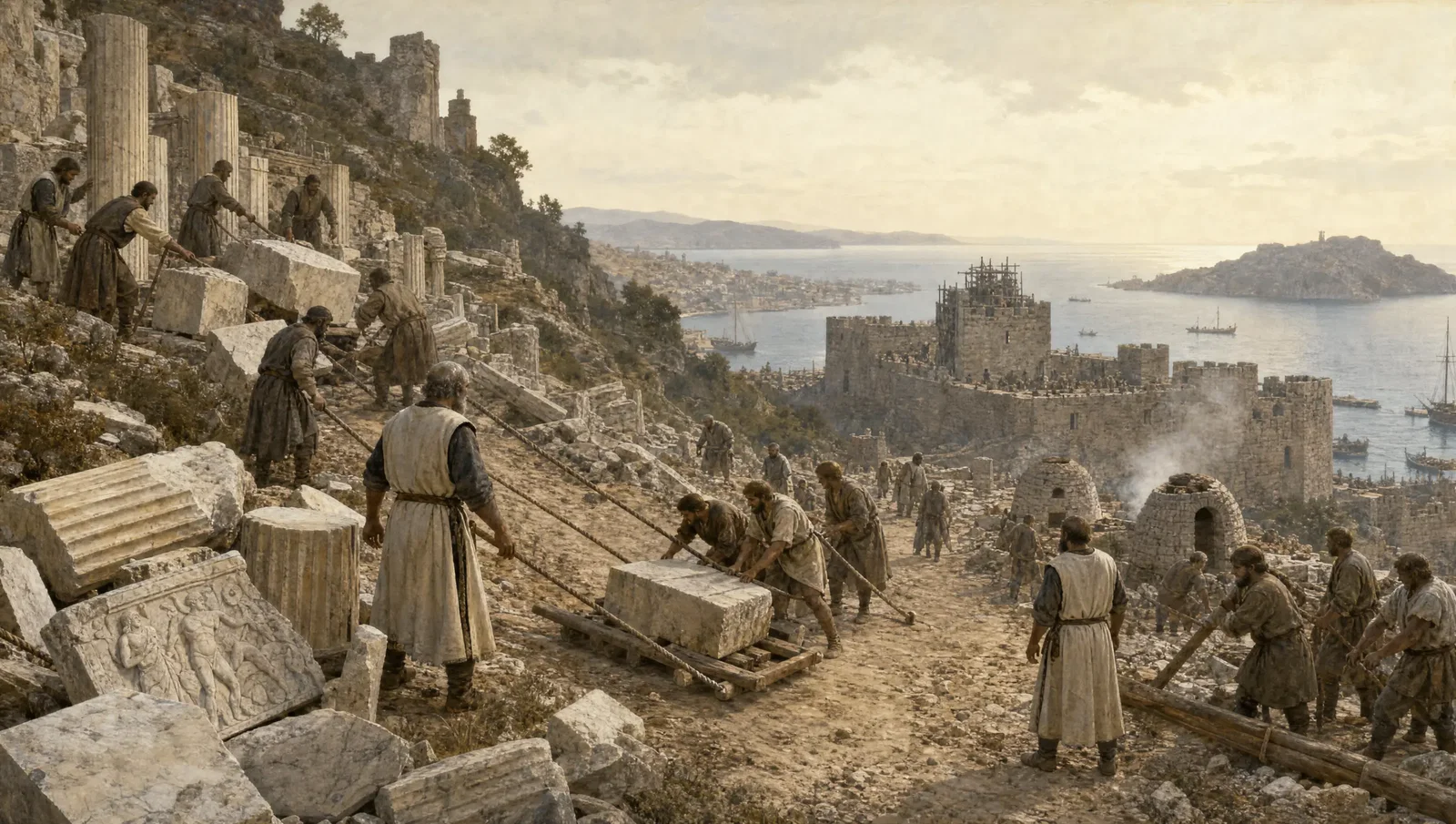
In 1402 the Knights of St John began building a fortress on the promontory below — the Castle of St Peter, which still dominates Bodrum harbour. They needed cut stone, and there was a collapsed wonder sitting a few hundred metres uphill.
Between roughly 1494 and 1522, the knights systematically dismantled what was left. The good blocks went into the curtain walls. Several of the Mausoleum's carved relief panels were set into the castle as decoration, where they stayed for centuries. The rest — including a great deal of fine marble sculpture — was burned in kilns for lime to make mortar.
So when you stand on the castle walls, you are standing on a Wonder of the Ancient World. It has simply been rearranged.
Follow the stones: London
The second exodus happened in the 1850s. The British archaeologist Charles Newton excavated the site and removed the relief slabs from the castle walls along with fragments recovered from the ground, including the colossal statues traditionally identified as Mausolus and Artemisia and part of a chariot horse.
They are in the British Museum's Room 21 today. It is the single largest surviving piece of the Mausoleum anywhere — and the reason so many visitors arrive in Bodrum expecting a monument and find a garden.
So what is left in Bodrum?
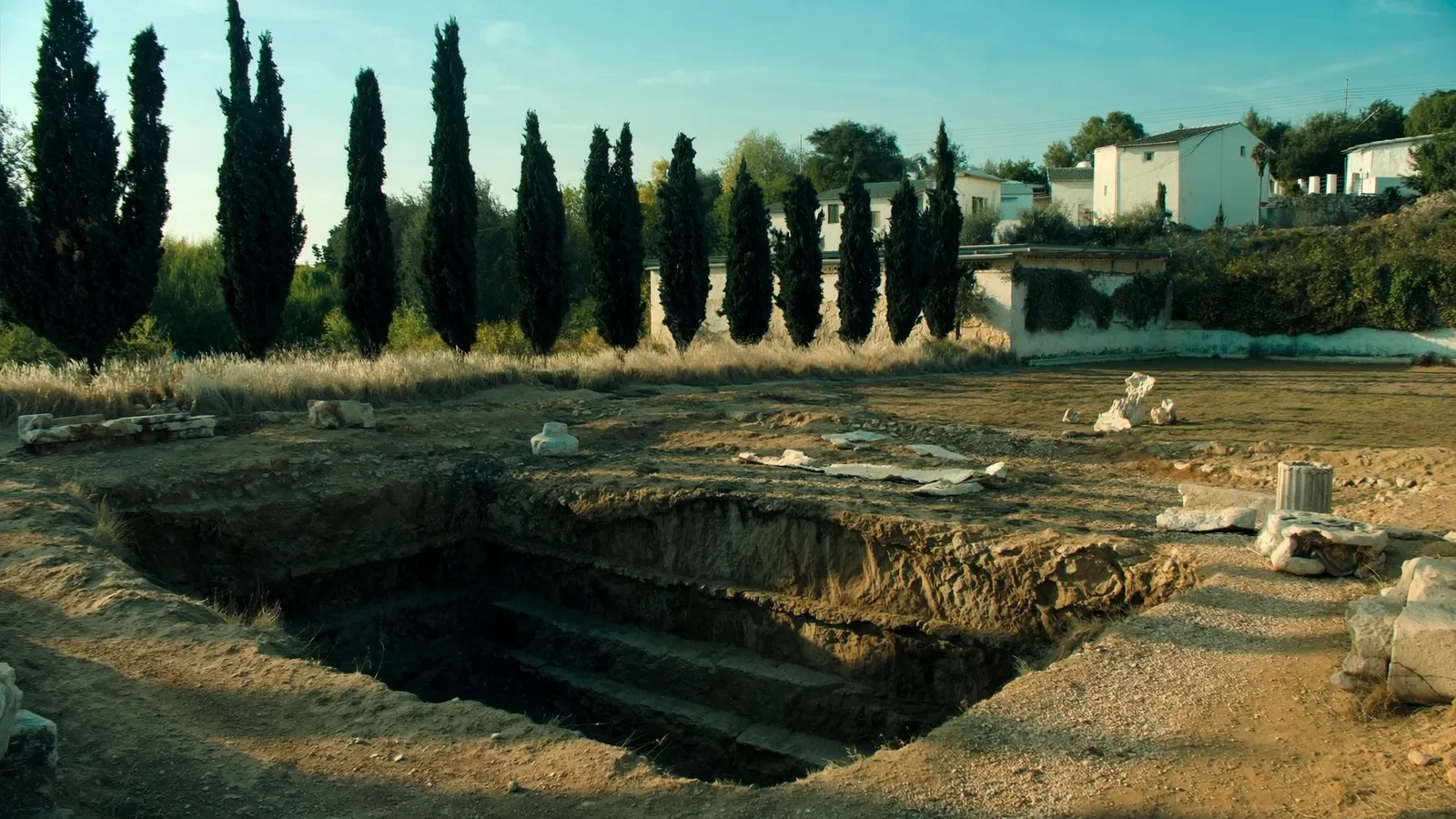
More than you would think, though none of it is tall.
- The foundations and the burial chamber. The rock-cut platform the whole structure sat on is still there, along with the stepped descent to the tomb chamber itself. You can see the scale of the footprint, which is the part photographs never convey.
- The drainage channels and quarry cuts in the bedrock — the working marks of a 4th-century BC building site.
- Column drums, capitals and fragments laid out around the enclosure, including pieces too broken to have been worth shipping.
- A small exhibition hall with a model of the reconstructed monument, plaster casts of the London sculptures, and the excavation history.
- Two green stone lions — later additions, but a favourite photograph.
The site sits in a quiet residential block behind the marina, on Turgutreis Caddesi, roughly ten minutes' walk uphill from the harbour. It is one of the calmest corners of central Bodrum in August, which is a recommendation in itself.
How to visit well
Give it 45 minutes to an hour. This is not a monument you photograph in five minutes; it is a site you read. Go in with the story and it becomes one of the most affecting places on the peninsula. Go in cold and it looks like a hole in the ground.
Go early or late. There is very little shade over the excavation pit. Between 12:00 and 16:00 in July and August it is punishing. First thing in the morning is best, and the light is better for photographs.
Pair it with the castle, in that order. See the Mausoleum first, then walk down to the castle and look for the Mausoleum's marble in the walls. Doing it the other way round loses the whole point.
Check opening hours the day before. Museum hours in Türkiye shift between summer and winter schedules and occasionally change at short notice. If we are looking after your stay, we confirm the day's hours before you set off.
Frequently asked questions
Is the Mausoleum of Halicarnassus worth visiting if nothing is standing?
Yes — with context. What you are visiting is the site, the footprint and the tomb chamber of one of the Seven Wonders, plus the exhibition that explains what stood there. Visitors who arrive expecting a standing monument are disappointed; visitors who arrive knowing the story rarely are.
Where are the Mausoleum's sculptures now?
The most significant surviving sculpture, including the statues identified as Mausolus and Artemisia and sections of the Amazon frieze, is in the British Museum in London, removed by Charles Newton in the 1850s. Other fragments remain in Bodrum, and reliefs remained embedded in Bodrum Castle's walls.
Why was the Mausoleum destroyed?
Not by war or deliberate demolition. A sequence of earthquakes between the 12th and 15th centuries brought the structure down, and the Knights of St John then reused the fallen stone to build and strengthen Bodrum Castle.
How long does it take to see?
Around 45 minutes to an hour, including the exhibition hall. Combined with Bodrum Castle and the ancient theatre, you have a comfortable half-day of ancient Halicarnassus without ever getting in a car.
Where exactly is it?
In central Bodrum, on Turgutreis Caddesi in the Tepecik neighbourhood, roughly a ten-minute uphill walk from the marina. Parking nearby is limited in high season — walking or a short transfer is easier than driving.
Seeing ancient Halicarnassus with Vega
Bodrum's ancient sites reward a little planning: the right order, the right hour, and someone who knows which gates are actually open that week. We build half-day private excursions around exactly this — the Mausoleum, the castle and the theatre with a guide worth listening to, an air-conditioned car waiting between stops, and a table booked for afterwards.
Tell us when you are here, and we will put the day together. For the wider picture of the peninsula, our Bodrum Guide covers what to see, when, and what closes when.
More Bodrum reading
- Bodrum Castle: the crusader fortress built from a Wonder
- The 3,300-year-old shipwreck hidden inside Bodrum Castle
- Gümüşlük’s sunken city: walk an ancient road into the sea
- Bodrum after dark: the hour-by-hour guide to a perfect night
Ancient Halicarnassus, in half a morning.
The Mausoleum, the castle and the theatre in the right order, at the right hour, with a guide worth listening to and a cold car waiting between stops. Tell us your dates and we will build the day.
Message us on WhatsApp — the fastest way to reach us, day or night. Prefer email or a form? Send us your dates and we will come back with a plan and a price.
More from the site: Excursions · Bodrum Guide · Activities & Experiences · Private Transfers
Images on this page are illustrative.